
Pocket Spring vs Memory Foam Mattress: Which Sleeps Better in Singapore?
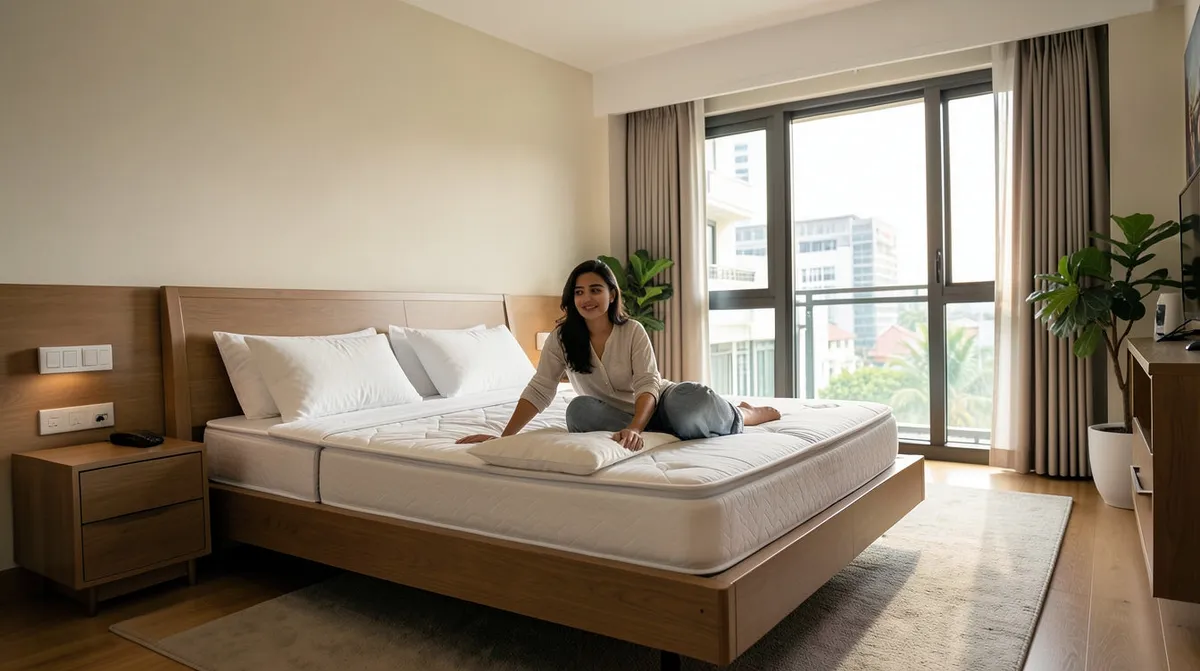
Ask around Singapore for why people recently switched mattresses, and "it was too hot to sleep on" comes up almost as often as "my back hurt." That's not really a coincidence. In a climate where night-time humidity barely lets up and the air conditioning isn't always running until morning, how a mattress handles heat and moisture matters just as much as how it handles your spine.
How pocket spring mattresses work
A pocket spring mattress is built from hundreds, sometimes well over a thousand, individual steel coils, each stitched into its own fabric pocket rather than wired together into one connected unit. Because each spring compresses on its own, the mattress responds to the specific weight and shape of each part of your body: your hips sink slightly while your shoulders and calves stay supported by springs unaffected by the movement right next to them. That's also why pocket spring mattresses tend to handle motion isolation reasonably well for a spring-based product. If your partner shifts around on their side of the bed, you're less likely to feel the whole surface move.
The open coil structure also lets air move through the mattress, and that airflow matters a lot in the tropics. Spring mattresses generally sleep cooler than solid foam, since the heat and moisture your body generates overnight has somewhere to escape instead of getting trapped against your skin.
How memory foam mattresses work
Memory foam is a viscoelastic material that softens with body heat and slowly moulds itself to your shape, then springs back once you get up. That gives it excellent pressure relief and contouring, which is why it's often recommended for people with joint pain, or anyone who sleeps mostly on their side, since it cushions the shoulders and hips instead of pushing back against them. Motion isolation is where memory foam really shines: because the material absorbs movement rather than passing it along, a restless partner is far less likely to wake you.
The trade-off is heat. Dense memory foam doesn't allow the same airflow as a spring structure, and the same slow-response quality that gives it that contouring feel also means body heat has fewer places to go. In a room without air conditioning, or during Singapore's warmer stretches, this can make a memory foam mattress feel noticeably warmer through the night, especially in the first hour or two before your body settles into a steady temperature. Plenty of newer memory foam mattresses now address this with gel infusions, open-cell structures, or cooling cover fabrics, so it's worth checking how a specific mattress is built rather than assuming all memory foam sleeps the same.
Edge support and long-term durability
Pocket spring mattresses tend to offer firmer edge support, which matters if you like sitting on the edge of the bed to put your shoes on, or if two people share a mattress and want to use its full width without feeling like they'll roll off. Memory foam edges compress more under concentrated weight. On durability, both materials can last well over a typical seven to ten year span, but spring units are more likely to show noticeable sagging once individual coils weaken, while foam wears down more gradually as its cell structure loses responsiveness, often showing up as a permanent body impression rather than a sudden drop in support.
Which suits a humid Singapore bedroom better
- Choose pocket spring if you run warm at night, share a bed and want firmer edge support, or your bedroom doesn't get air conditioning for most of the night
- Choose memory foam if pressure relief and motion isolation matter more to you than temperature, and your room stays reasonably cool
- Either way, use a mattress protector and let the room air out during the day. Trapped humidity encourages mould and dust mites in any mattress, foam or spring
- Rotate the mattress from time to time, and avoid tucking sheets so tightly that airflow around the mattress gets blocked
Neither construction wins outright. It really depends on how warm your room runs and what your body responds to. The only real way to know is to lie down on both for a few minutes each, which you're welcome to do at a Nova Furnishing showroom before deciding. Message us on WhatsApp if you'd like to arrange a time to come try a few side by side.
Related Articles
How to Maintain Your Mattress for Maximum Lifespan in Singapore
Simple mattress habits that make a real difference in Singapore's climate: rotating, airing out, using the right protector, and knowing when it's time for a new one.
27 March 2026
Natural Latex vs Synthetic Latex Mattress: Is the Premium Justified?
Natural and synthetic latex get lumped together as one product, but they sleep very differently once Singapore's heat and humidity get involved. Here's what actually separates the two.
25 March 2026
When Should You Replace Your Mattress? Honest Signs It's Time
The honest signs a mattress needs replacing, from morning aches to a musty smell in Singapore's humidity, and what to check before you decide.
25 March 2026
What to Test When Shopping for a Mattress: A Showroom Checklist
A hands-on showroom checklist for testing mattress firmness, support and heat retention before buying in Singapore's climate.
19 March 2026